
General Confusion
A General's recent statement to the Public Accounts Committee on the Ajax fiasco were confused or deliberately misleading. Neither is acceptable.
Lord Robertson made headlines when he described the “corrosive complacency” that infects the Ministry of Defence and the upper levels of the Armed Services. It’s worse than that; the MOD has a culture of not speaking the truth to power and of believing its own publicity. There was a classic example last month.
On 24th March, Lieutenant General Anna-Lee Reilly, the Director General Core Delivery for Defence Equipment & Support, faced the Public Accounts Committee (PAC) in Parliament. One of the subjects of discussion was Ajax, the army’s £6 billion new reconnaissance vehicle. In a ministry famed for its inability to buy stuff on time, Ajax stands out as a disaster without equal.
I have written extensively on the MOD procurement disaster that is the Ajax programme, not least because I was quite heavily involved in the early stages of it as both a soldier and an expert consultant. (Spoiler: none of the analysis or operational research concluded that the answer was a 40-tonne behemoth). Following massive delays and quality problems, the latest problems arose when an exercise had to be stopped last year due to the crews becoming ill.
With £6 billion at stake (the equivalent of a dozen Type 31 Frigates and change), the PAC was keen to establish the cause. The General told them that Ajax was fine when it was operated within specifications, but if the tracks weren’t kept tight (i.e. within specification) problems would occur. She revealed that the Army was now working with General Dynamics towards Ajax 2, which would have rubber tracks and automatic track tensioners. She anticipated trials later this year.
Intriguingly, that’s the first anyone has heard of Ajax 2. Conservative MP Ben Obese-Jecty has submitted a written question asking precisely what Ajax 2 is. The answer is due on 13 April. It’s the 17th today: no reply has yet been published.
The committee was quite kind and didn’t press the general further. One member, decorated and retired Colonel Lincoln Jopp MP, asked whether the specification was wrong or the crews had not been properly trained. The General evaded and replied that the exercise was quite long and that the troops involved had lost experience of operating in armour due to the time the Army had spent campaigning in Iraq and Afghanistan.
That sounds like blaming the crews to me. It also sounds like obfuscation.
General Inconsistencies
For a start, the Army left Iraq in 2011 and that war involved armoured vehicles. It left Afghanistan in 2021 and that too involved armoured vehicles, including the Scimitar 2, the tracked reconnaissance vehicle that Ajax will supposedly replace. There may have been some skill fade given covid and cuts, but people who served as troopers in Afghanistan are now corporals, that is vehicle commanders. They will have had (or should have had) extensive training for that and again extensive training on Ajax before they took them over.
Secondly, while Exercise Titan Storm was scheduled for about a month, that’s hardly “quite long”. Moreover, Titan Storm was a far wider exercise spread across southern England. The Ajax bit on Salisbury Plain was shorter, and the damage to soldiers arose from just 10 to 15 hours in the back of an Ajax. That’s not a long time for an armoured soldier to be in their vehicle; if anything, it’s a short day. The General should know this from personal experience; in her youth she spent a couple of years as the workshop manager to the team of mechanics supporting an armoured reconnaissance regiment. That included time at war in Iraq, but perhaps she’s forgotten the basics.
I contacted the MOD and asked why a problem caused by a lack of training was to be solved by a vehicle modification. A Ministry of Defence spokesperson said:
“The safety of our people is of paramount importance. Issues with Ajax are not the fault of soldiers and clearly the experience for many soldiers using Ajax has not been good enough. An extensive safety investigation into Exercise Titan Storm has now concluded and we are working through the findings. We will provide a full update to Parliament on the review and the next steps for the Ajax programme.”
Which is far from illuminating. The MOD’s spokesman is hiding behind a forthcoming statement to Parliament to be made by Luke Pollard Minister for Defence Readiness and Industry. However Lt Gen Reilley’s statement that “After various safety reports, we are now very clear that Ajax, when maintained and operated as designed, presents no safety concerns.” Is pretty definitive.
The question becomes why Ajax was operated with loose tracks, i.e. out of specification. Either the crew didn’t keep them tight (tightening tracks is a routine maintenance procedure for all armoured fighting vehicles) or Ajax has a propensity to loose tracks. If the spokesperson is correct that soldiers (i.e. the Ajax crews and/or the soldiers who trained them) are not to blame, the tracks must be becoming loose very quickly. That’s a design error or specification error. The general rather hinted at that as she went on:
“However, we now need to work with General Dynamics and Ministers to make sure that we can get Ajax back into service in a measured way, where we can assure that safety, and assure our position.”
Why do ministers need to be involved? If it’s a training problem, as the General implied but the spokesperson denies, ministers have no role. If it’s a specification problem or a manufacturing problem it should be covered by the contract. That’s a matter for lawyers, not Ministers. Unless of course, the Army or MOD made a hash of the specification and are now having to pay for a fix, throwing more of our good money after bad.
The entire Ajax fiasco is littered with oddities. How is it that during over 42,000 km of trials the track tension problem either did not manifest itself or was not noticed? Why was Ajax’s Initial Operating Capability (IOC) declared prematurely?
Track Facts
Armoured vehicle tracks are surprisingly complicated and have a very tough existence. On Ajax they comprise some 80 individual links, which weigh about 25 kg each. The drawing below comes from one in my book on land warfare.
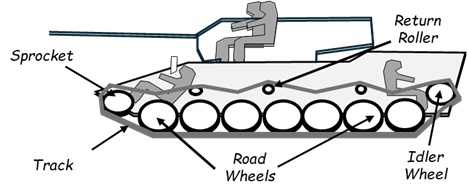
The idler wheel, return rollers and sprocket are bolted to the hull. The sprocket also has a connection to the gearbox and engine, as it delivers the power into the track by a cogwheel that engages in slots in the individual track links. The idler wheel, return rollers and sprocket have no suspension but do have rubber tyres to reduce vibration. The road wheels are also rubber-tyred and connected to the hull. They carry the entire weight of the vehicle and do have suspension. Clearly any vibration in the track will be transmitted to the hull.
The crew live inside the hull; any vibrations in the track will pass through the wheel attachments to them. Imagine sitting in a dark metal box with several people hammering on the outside while it bumps about and you get the picture. This is not new; soldiers (including me) have been sitting in the back of armoured vehicles for decades. Motion sickness is sometimes a problem, but sound (or ultrasound) damage, which seems to be what has happened to Ajax crews, is well outside of the norm because it is designed out.
A track link on the ground is static, even if the vehicle is moving. The Ajax’s seven road wheels pass over it, each delivering a load of two to three tons. Once the seventh wheel has passed the link starts to rise and then goes round the idler wheel. During that time it accelerates to twice the vehicle speed. If the Ajax is travelling at (say) 30 mph, the track link accelerates from 0 to 60 mph in two hundredths of a second, pulling some 130 g. When the link gets to the front of the vehicle it goes round the sprocket and slows from 60mph to zero in an equally short time. It is then laid on the ground and the process repeats. On top of those loads, the sprocket is putting the power that moves the Ajax into the track, some 300 horsepower on each side.
This places a huge load on the track link and the idler, which is bolted to the vehicle’s hull. The track tension varies as the vehicle moves over uneven ground and the road wheels go up and down. With time the track link stretches, the idlers, sprockets and wheels wear and the track slackens. It has more freedom to move, causing more vibration and noise. If a track gets too loose it might jump off the wheels, or even break.
Dealing with a thrown track (as it is known when a track comes off the wheels) means hard work for the crew getting it back on. If a track breaks, the end acts like a whip and is potentially lethal. (On Scimitar broken tracks often flipped vehicles onto their roofs.) Every armoured vehicle crew keeps a very close eye on the amount of slack in the tracks for reasons of self-preservation.
Maintaining Tension
Track tension is usually gauged by the top of the track’s location in relation to a reference point on the hull. This can only be done on hard level ground (known as ‘hard standing’); if the roadwheels are not level, the track slack at the reference point will be misleading.
Ajax has side skirts, which are metal sheets that enclose much of the track system. Side skirts reduce dust and prevent things like rubble or broken branches from throwing the track. Side skirts also contribute to the vehicle’s protection. To view the top of the track one must remove the skirt, which usually pivots downwards. Opening the skirt takes a couple of crewmen a couple of minutes. Ajax has very thick (and heavy) side plates, which makes this essential task more difficult. It shouldn’t make it impossible.
The track is tightened by moving the idler wheel, which is mounted either on a screw thread or at the end of a hydraulic piston. A few minutes’ work with a (huge) spanner, grease gun or hydraulic ram tightens the track until the slack is correct.
A well-designed tracked vehicle should be able to operate with the tracks remaining sufficiently tight for a couple of days. The tension duration is controlled by the design of the track tensioner and the operating procedures. Both these would be included in the specifications, which would have been issued by the MOD on behalf of the British Army, specifically by one of Lt Gen Reilly’s predecessors.
Ajax was based on an existing vehicle (ASCOD) but it’s much heavier, so the entire track system was redesigned. Perhaps the track tensioner wasn’t? If not, it’s not surprising that it can’t keep the track taut for the required time. That would be a design or specification error and definitely “not the crew’s fault.” It would still be inexplicable, though, as Ajax had some 42,000 kilometres of testing. A weak track tensioner would surely have shown up. That it didn’t implies the trials were flawed.
What is certain is that no vehicle should be having these problems post IOC. The civil servant responsible, Chris Bowbrick, has been sacked, or rather “removed from post” – the sacking of senior civil servants (or generals for that matter) being as rare as unicorn tears. That still leaves the Army with a vehicle that doesn’t work and a trials process that failed. Somehow Lt Gen Reilley has been persuaded that the solution is to adopt composite rubber tracks and automatic track tensioners as the Army transitions to Ajax 2 (whatever that is). She hopes that trials on composite tracks will start late this year.
That makes no sense and isn’t consistent with her previous answers. If the track tension problem was due to poor crew training, why is it necessary to spend yet more money the government doesn’t have on (Gucci) composite tracks? A quick revision course is all that would be needed. Learning to tension a track correctly takes less than half a day and £0 capital cost.
The responsibility for Ajax has now been transferred to the (new) National Armaments Director, Rupert Pearce. A hotshot businessman, Pearce was CEO of the green energy company Highview Power and satellite communication company Inmarsat. He has no experience in defence or turning organisations round. His failing directorate has an astonishing 28,000 staff purchasing most of the MOD’s equipment – (his remit doesn’t cover the nuclear bits).
Ajax’s tracks came up at his initial discussion with the defence select committee in January. Pearce (again appearing alongside General Reilley) said “…There has been an evaluation in the past about installing rubber tracks. At the moment, Ajax does not have rubber tracks; it has metal tracks, which are seen as operationally superior.” So the Reilley solution produces an operationally inferior vehicle which, according to Reilley, isn’t necessary as the tracks weren’t the problems, the crews were.
General Cowardice
Elsewhere in his January evidence Mr Pearce alluded to a culture where people were afraid to speak the truth to power within the MOD. He said “It is evident from the report of Mr Sheldon KC that there were opportunities in the development programme that were missed because it was difficult to speak truth to power.” (Sheldon published a report into Ajax in 2023). And there Pearce has hit the nail on the head; the MOD and armed forces are full of people afraid to speak the truth to power or, moral cowardice (as we would have described it when I taught at Sandhurst).
The Army’s leadership is riddled with moral cowardice – it’s not just Ajax. The 300 or so complaints of sexual assault are currently being investigated, and the weakness of those investigations speaks of a hierarchy that is rotten, as I wrote in November. Organisations in which people fear speaking truth to power are doomed to failure, as the Army is currently demonstrating.
Organisational culture is set from the top. Like fish, organisations rot from the top; stopping the rot requires senior leadership change. The longer you wait, the worse it becomes. The Secretary of State for Defence, John Healey is, I’m told, a decent man. But he’s been in post for two years (and was shadow secretary of state for defence for four years). He must realise the problems, yet he does nothing.
He should be sacking generals (and admirals and air marshals). Probably all of them. He should be asking why we have so many headquarters to supervise so few forces. He should open a whistle-blower campaign to find out which idiot is responsible for the Ajax track tension disaster. But of course he won’t. He’s a career politician serving under a prime minster who can’t even sack an energy secretary. Driving reforms through takes someone who has led real businesses in the real world.
It will be interesting to see how long Mr Pearce can endure the stench of a rotten ministry. His chunky salary (£400K plus a £250K bonus) will ease the pain, but he’s not senior enough to solve the problems, which start with Lt Gen Reilley and her ilk. No sensible government, particularly one as cash-strapped as this one, would spend any more on defence until the organisation had been made fit for purpose. Healey has the position to do that, but not the ability. Pearce might have the ability but lacks the mandate. It’s a classic UK government arrangement, with failure designed in.
Rather like Ajax.
If you enjoyed this article please remember that Views From My Cab is a reader-supported publication and subscribe, which costs you nothing but makes the SubStack bots more helpful.
Alternatively you could make a small, one off donation to defray my production costs. I am hugely grateful for every donation. The simplest method is via Buy Me a Coffee.
Ajax was developed from an earlier European model by General Dynamics based in Oakdale/Newbridge in South Wales. This is the same General Dynamics that was responsible for the Army's Bowman radios. Draw your own conclusions.
This is a forceful critique of a programme that clearly warrants scrutiny. But it is more confident about causation than the available evidence justifies.
The argument reduces the problem to a choice between training failure and design failure, with track tension as the implied mechanism. That is an oversimplification. The issues publicly associated with Ajax, including vibration, noise, integration, and delayed usability, point to a system-level failure rather than a single-point defect. In complex platforms, these effects emerge from the interaction of design, operating conditions, maintenance, and institutional use. Isolating one variable and treating it as decisive risks misidentifying symptoms as causes.
The same applies to the treatment of official statements. ‘Safe within specification’ and ‘not the soldiers’ fault’ are presented as inconsistent. They are not necessarily so. A system can meet technical specifications while proving unsafe or impractical under realistic conditions. The gap between designed performance and usable performance is well established in complex systems and does not require either confusion or bad faith to explain it.
More broadly, the piece treats ambiguity as something that must be resolved into either incompetence or deception. That framing is too narrow. Defence systems are only partially legible by design. Readiness is distributed across personnel, logistics, maintenance, training, and industrial capacity, much of which cannot be exposed without distortion or risk. Under those conditions, explanations are often incomplete and indirect. That is a structural constraint, not in itself evidence of evasion.
There is also a more fundamental issue. The analysis remains at the level of the programme, when the pattern is systemic. Ajax is not unusual because it failed. It is typical of how capability struggles to translate from technical form into operational effect within existing institutional structures. Focusing on whether tracks were correctly tensioned does not address that problem.
The more relevant question is why failures of this kind persist across programmes with different technologies and contractors. That points towards procurement architecture, risk distribution, and the capacity of institutions to absorb new capability, rather than a single technical fault or a single misleading statement.
For a broader treatment of these constraints, particularly institutional absorption and the limits of publicly legible readiness, I have written about it here:
https://observatoryanalysis.substack.com/p/capabilitys-problem-is-not-technologyit
https://observatoryanalysis.substack.com/p/why-readiness-is-discussed-more-than